What is a city without
history? Just stones. This saying is so perfectly true in the case of the
Wroclaw Industrial Park. All that is so interesting there would have no meaning
without the fascinating and rich history behind it. It would be just buildings…
 |
Linke und Hoffmann Werke AG Breslau 1914
source: Biblioteka Cyfrowa Uniwersytetu Wrocławskiego |
The area I am talking
about has the size of 163 hectares and
its beginnings date back to 170 years ago, when in 1839 Mr Gottfried Linke – the owner of a small manufacture of horse
saddles and carriages got an order for delivering 100 special railway carriages
needed for the construction of Uppersilesian Railways. From one day to the next his small workshop
had to transform into a much bigger one and then moved to new locations a few times
as he needed more and more area. The factory of Wagenbauanstalt Gottfried Linke
was growing all the time, together with the dynamic development of the railway
industry. Their product portfolio included freight and passenger carriages as
well as locomotives.
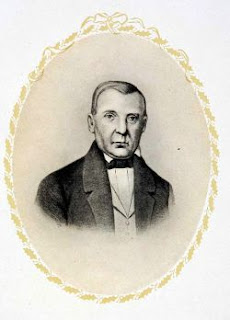 |
Gottfried Linke 1792-1867
source: Biblioteka Cyfrowa Uniwersytetu Wrocławskiego
|
At 59 Strzegomska street, which was then the area outside
the city, they bought a piece of land to build a storehouse of wood and a
lumber mill, which later - at the beg. of the 20th century was
expanded into one of the production plants. At the end of the 19th
century Linke sons built nearby a new plant for building machines and locomotives,
however, it was not enough and 11 years later a new huge plant was built for
assembling train carriages. The Linke factory was recognized in Europe and
worldwide. They received many rewards at international fairs and exhibitions. The
size of the plant exceeded the size of the Wroclaw old town and the market square.
 |
Map of LHW, 1914
source: Biblioteka Cyfrowa Uniwersytetu Wrocławskiego
|
 |
Johann Hoffmann 1803-1879
source: Biblioteka Cyfrowa Uniwersytetu Wrocławskiego |
Their biggest
competitor was a railway carriage factory run by Mr Hoffmann. And what do you
think they did about it? In 1912 they
merged together and changed the name into Linke
und Hoffmann Werke AG Breslau (workshops of Linke and
Hoffmann). The company was thriving. They cooperated with various other
suppliers and soon the whole factory became the largest factory in Wroclaw and
one of the greatest manufacturers of railway carriages and locomotives in Europe employing about 5000 people. In total there
were produced as many as 20.000 railway carriages, including the famous and very luxurious VIP
train for German emperors. Also trams were on their offer.
 |
Locomotive no. 2000, 1920
source: Biblioteka Cyfrowa Uniwersytetu Wrocławskiego
|
 |
A city tram, 1920
source: Biblioteka Cyfrowa Uniwersytetu Wrocławskiego
|
 |
Locomotives no.1, 100, 500
source: Biblioteka Cyfrowa Uniwersytetu Wrocławskiego
|
After the crisis of
1929 they had to stop producing the locos with the last one which had the
number of 3077. In 1934 their two depots (including the locomotive production
plant) were sold out – one was bought by Junkers and focused on manufacting machines
under the name of Fahrzeug und Motoren
Werke (FAMO), its post-war successor being the Dolmel factory. LHW focused on
the production of train carriages only. Their products were exported to many
countries.
 |
| LHW HQ building, 1914 |
 |
after work, 1914
source: Biblioteka Cyfrowa Uniwersytetu Wrocławskiego
|
During the I and IIWWs LHW were manufacturing also armaments – the
so-called Walfish (whale) planes – reconnaissance aircraft in the IWW and parts
of V2 rockets and armoured trains in the IIWW. It was also a branch of the nearby
Gross Rosen concentration camp in years 1941-1942 , where the prisoners were
forced to work. Most of them worked in the adjacent FAMO plant (there is a
beautiful memorial opposite the main office building, inside the park).
 |
armoured trains
source: Biblioteka Cyfrowa Uniwersytetu Wrocławskiego
|
parts of V2 rockets
source: Biblioteka Cyfrowa Uniwersytetu Wrocławskiego
In May 1945 LHW is taken over by the new authorities and given a name of State Carriage
Factory PaFaWag – the name comes from the first letters of the long full name
of the company (Państwowa – state, Fabryka – Factory, Wagonów – of carriages), and, although the factory was destroyed in
80% during the war, the first open freight carriage for transporting coal and
other goods was produced as early as in November 1945. It was made mainly from
post-German parts and the missing parts were made hand-made, thanks to Polish people’s
resourcefulness.The company employed 1500 people at the end of 1945. The
newcomers to Wroclaw, seeing the works in full swing would jump off their train
and join the crew. After the restoration and modernization it was again the
biggest industrial company of Wroclaw with the size of 70 hectares and at its
best times - with 6000 (some say 10 000) employees. It was the only Polish supplier of trains
that were suitable for Polish electrical traction system. It was also a
flagship socialist factory, initiating some social actions of e.g. restoring the
city of Wroclaw. Each big achievement, e.g. the 1000th freight carriage was a
big political and social event, which was widely publicized and celebrated –
the aim was to motivate to even harder work. Many communist VIPs, heads of the
communist party and Soviet Union high dignitaries visited the factory.
 |
| Socialist propaganda in Pafawag |
They
were manufacturing all range of electrical and diesel locomotives and various
types of carriages, passenger and freight ones, diesel and electrical multiple
units - mainly for Polish Railways, but
also loads of the products were exported to India, China, Soviet Union,
Czechoslovakia, Yugoslavia, Morocco, Syria, Iraq or Greece, Holland. In total they produced 2231 electrical locos and 1633
EMUs. With about 6000 people working there Pafawag grew into a kind of a
town – they had their own nursery, kindergarten, vocational school, health
centre, sport clubs, cinema. Pafawag goods were famous for their innovative
technological solutions and most of them are still in operation. The factory
was the national pride and its name has been known all over Poland! The factory
is one of the oldest in Europe.
 |
| Pafawag factory inside, 1950-1960/source: Foto Polska |
From 1989 to 1996 with
the change of the political system in Poland, the company suffers problems of
fewer and fewer orders. The volume of railway
transport decreases, being driven out by
the increased car transport. Polish railways, the main and regular customer
also have problems and withdraw from ordering. The employment rate drops. In ‘97
the company is taken over by Adtranz (ABB and DB) under the condition of obtaining
a big order from Polish Railways for 50 modern locomotives. Unfortunately the Polish
Railways were never able to pay for them.
From May 2001 Pafawag
traditions are continued by a Canadian company of Bombardier Inc. Their
division of Bombardier Transportation is the world leader in the production of
rolling stock and railway equipment. In Wroclaw, they still occupy three huge
depots, as in the old good times, but the products include only locomotive
carbodies and railway bogie frames. The locomotive carbodies from Wroclaw run
in Greek, Swedish, Swiss, American and Malaysian locomotives. They are used in
superfast ICE trains operated in Germany and Holland as well as in the Spanish
high-speed Talgo locomotive (350 km/h).
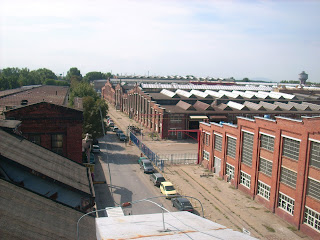 |
former Linke und Hoffmann Werke - present Bombardier Transportation Polska
Photo by Krzysztof Kulig |
The other part of LHW,
the former FAMO factory (successor of LHW locomotive and machine factory) which
is adjacent to the former Pafawag part of the park was changed into Dolmel,
which was almost as big as its neighbour. They were manufacturing turbines and
generators on a huge scale, but it can be as well said that the main life was
revolving around more interesting things like
parties, socializing, pursuing artistic or sport passions, love, family life,
solidarity movement and a spontaneous opposition reaction to the introduction
of the martial law in 1981. Piotr Bednarz, the legend of Wroclaw Solidarity and
one of the three musketeers, who saved 80 million PLN belonging to the trade
union, had been working there.
 |
| FAMO in 1945/source Foto Polska |
 |
| advertisement leaflet of FAMO/source: Foto Polska |
 |
Giving the name of F. Dzierzynski to Dolmel, 21.07.1951
source: Foto Polska |
 |
Dolmel factory, assembling the 125MW generator 1960-63
source: Foto Polska |
 |
Dolmel, inside the factory 1950-60
source: Foto Polska
|
In 1990 a part of Dolmel was bought by ABB and
then by Alstom and currently is one of the leading providers of huge superpowerful
generators used also in nuclear power plants. The other sections of the industry formed
separate companies.
One of them – Dozamel Sp. z o.o. is the manager of the
Wrocław Industrial Park. The idea of establishing the park finally came into
life on 14 March 2005, when the Municipality and the following companies: DOZAMEL
Sp. z o.o., Archimedes S.A. oraz Wrocławski Park Technologiczny S.A. signed an
agreement. Later they were joined by Bombardier Transportation Polska Sp. z
o.o. i Wojdyła Inwestycje Sp. z o.o. The main target is the revitalisation of
this historical industrial area as a unique and uniform territory registered as
a historical area with over one hundred years of industrial traditions. They also provide new businesses with ready infrastructure, aim at creating new workplaces, offer training sessions and want to keep the park in line with modern technologies. The park area is the same as 170 years ago (163 hectares) and it is divided into three parts called by the names of the three big post-war factories Pafawag, Dolmel and Archimedes.
 |
A modern building of conference centre
source: Dozamel Sp. z o.o. |
Present times: a film about the Wroclaw Industrial Park
I used some of the information from the blog wroclawzwyboru.blox.pl